Showing posts with label penzberg. Show all posts

Wednesday, November 15, 2023

Road tripping in Germany - 6 - Augsburg

 At a distance of around 120 kms from Penzberg is the beautiful city of Augsburg so that was our next destination which took us about an hour and a half on the wonderful German roads with its disciplined driving.

Augsburg is a historic city located in the Bavaria region of southern Germany. It is the capital and largest city of the Augsburg district and is known for its rich history, culture, and economic significance. It is one of Germany's oldest cities, with a history dating back over 2,000 years. It was founded by the Romans in 15 BC and was originally known as Augusta Vindelicorum. The city played a significant role during the Roman Empire and the Middle Ages.

Augsburg is renowned for its role in the Renaissance period, as it was the home of the influential Fugger family, who were successful merchants and bankers. The Fugger family's wealth and influence left a lasting impact on the city, as seen in structures like the Fuggerei, a historic social housing complex.

The Augsburg Town Hall is a prime example of Renaissance architecture and is celebrated for its intricate and beautifully designed façade. It was constructed in the late 16th century, with the main architectural style being High Renaissance. The façade features ornate stucco decorations, statues, and detailed reliefs. 
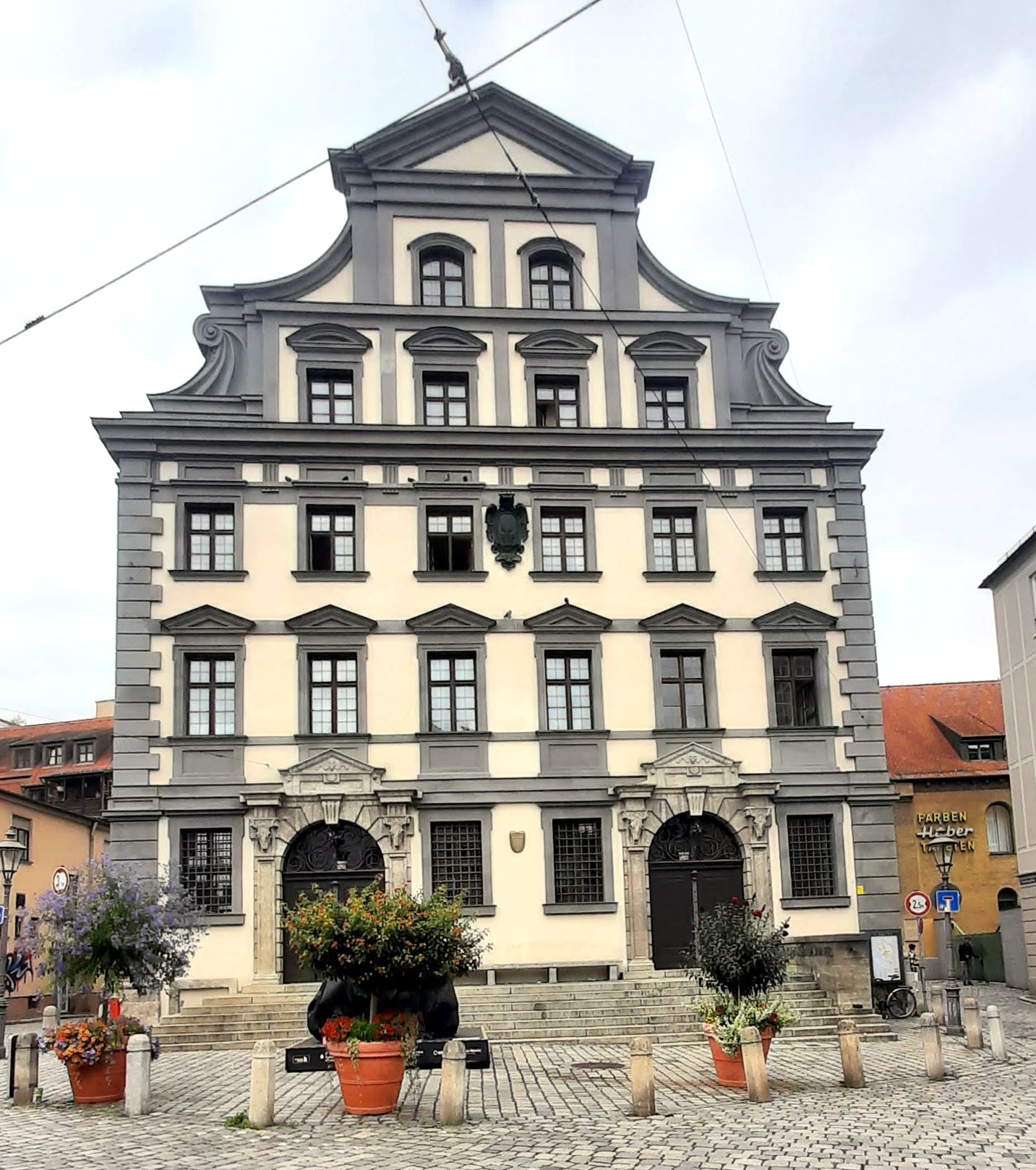
Stadtmetzg - The trade guild house of the Butchers' Guild was constructed in 1609 in Rennaissance style. It featured an innovative system for keeping the meat cool and to dispose waste by guiding the ‘Vorderer Lech’ canal through the basement of the building. 

The Augustus fountain is a masterpiece of Renaissance architecture and sculpture. It was constructed in the early 17th century and designed in the style of the German Renaissance.  The fountain's central figure is a statue of Emperor Augustus (also known as Augustus Caesar), the first Roman Emperor. Augustus is depicted in imperial robes, holding a sceptre and orb, symbolizing his imperial power and authority. 

Rathausplatz is located in the heart of Augsburg's Old Town, making it easily accessible and a central point for exploring the city. 

St. Peter am Perlach, also known simply as St. Peter's Church (St. Peterkirche), is a historic church and has a long history, with the original church dating back to the 10th century. The current Baroque building was constructed in the 18th century. 

The Fuggerei is a historic social housing complex located in the city of Augsburg, Bavaria, Germany. It was founded in 1516 by Jacob Fugger the Younger, a member of the Fugger family, who were successful German merchants and bankers during the Renaissance period. 

Statue of Jakob Fuggerei


The Fuggerei is notable for being one of the world's oldest social housing estates that is still in existence. It was established with the intention of providing affordable housing to those in need. The Fugger family's endowment specified that the rent for the residents should be one Rheinischer Gulden per year, as well as the requirement to recite three prayers daily for the Fugger family's well-being. 

Today, the Fuggerei continues to operate as a charitable housing complex. The annual rent is still only a symbolic amount, equivalent to the original one Rheinischer Gulden, which is about 0.88 euros. Residents of the Fuggerei are usually required to be of the Catholic faith and to meet certain eligibility criteria. The complex consists of 67 houses with 142 apartments, and it remains an important historical and cultural site in Augsburg.

That was the end of our wonderful visit to Augsburg and we headed back to Penzberg to drive onwards next day to Bühlertal.

Linking with Mosaic Monday

Wednesday, October 11, 2023

Road tripping in Germany - 4 - A Day trip to Neuschwanstein and Füssen.

Neuschwanstein Castle, located in Bavaria, Germany, is one of the most famous and iconic castles in the world. The distance from Penzberg was just 70kms hence this was our next one day trip which we


 combined with a visit to Füssen that was just 5kms away from Neuschwanstein.

Neuschwanstein Castle, which means "New Swan Stone Castle" in English, was constructed in the 19th century. It was commissioned by King Ludwig II of Bavaria and was built as a retreat and homage to the composer Richard Wagner, whose work greatly inspired the king. It features a blend of architectural styles, including Romanesque and Gothic Revival elements.

You can either walk it up to the castle (an easy stroll)

Take the bus

Or take the horse drawn carriage.

Construction of Neuschwanstein Castle began in 1869 and was never fully completed during Ludwig II's lifetime. The king lived in the castle for only a short time, and it remained incomplete at the time of his death in 1886.

It served as the inspiration for Disneyland's Sleeping Beauty Castle, and its fairy-tale appearance has made it an iconic symbol of German Romanticism.

The awe inspiring Neuschwanstein castle.

The Hohenschwangau Castle viewed from Neuschwanstein.

In addition to visiting Neuschwanstein Castle, the nearby Hohenschwangau Castle, which was the childhood residence of King Ludwig II, is also a popular attraction. The picturesque Alpsee Lake is in the vicinity, offers opportunities for boating.

Hohenschwangau Castle, which means "High Swan County Castle" in English, has a history dating back to the 12th century. It was originally built as a fortress by the Knights of Schwangau and was later expanded and renovated by various owners over the centuries. In the 19th century, Hohenschwangau Castle was owned by Maximilian II of Bavaria, who was King Ludwig II's father. The castle served as the royal summer residence for the Bavarian royal family.

The castle is primarily built in the neo-Gothic and neo-Romanesque architectural styles. It features picturesque towers, turrets, and courtyards, making it an excellent example of Romantic-era architecture. King Ludwig II spent much of his childhood at Hohenschwangau Castle. His upbringing in this castle had a significant influence on his later architectural and artistic interests, which would lead him to commission Neuschwanstein Castle.

Due to its secluded and strategically unimportant location, the palace survived the destruction of the two World Wars. Until 1944, it served as a depot for Nazi plunder that was taken from France by the Reichsleiter Rosenberg Institute for the Occupied Territories (Einsatzstab Reichsleiter Rosenberg für die besetzten Gebiete), a suborganisation of the Nazi Party. In April 1945, the SS considered blowing up the palace to prevent the building and the artwork it contained from falling to the enemy. The plan was not realised by the SS-Gruppenführer who had been assigned the task, and at the end of the war the palace was surrendered undamaged to representatives of the Allied forces. The Allied occupation authorities eventually returned the palace to the reconstituted Bavarian state government.

Füssen beckoned and off we headed to visit yet another pretty town of Bavaria!


Füssen's Old Town is a charming area with cobblestone streets, colorful buildings, and historic churches. St. Mang's Basilica is a notable church worth visiting.

The St. Mang Basilica, also known as St. Mang's Church (St. Mangkirche in German), is one of the prominent landmarks in Füssen and is known for its historical and architectural significance.


The church is named after St. Mang, a Christian martyr who lived during the 3rd century. St. Mang is considered the patron saint of Füssen, and the church was built to honor his memory. It is a fine example of Baroque architecture. 


The church was built in the 18th century, with its exterior characterized by its stunning facade and a picturesque onion dome. The interior features ornate decorations and frescoes, making it a beautiful place of worship.

It hosts regular Catholic services and ceremonies.

The Brotbrunnen, also known as the "Bread Fountain," is a notable landmark in Füssen's Old Town. It was constructed in the late 16th century and served as a source of fresh drinking water for the townspeople. The name "Bread Fountain" is symbolic, and like similar fountains in other towns, it was associated with charity. In times of famine or scarcity, bread would be distributed to the needy from this fountain. It was a way to provide assistance to the less fortunate.

The Church of the Holy Spirit (Heilig-Geist-Spitalkirche) is a historic church that dates back to the 18th century constructed between 1747 and 1750. It is known for its beautiful Rococo architecture and hosts regular Catholic services and religious ceremonies.

Overall we had a fun day taking a walk down historic Bavaria and drove back to Penzberg in the evening. The commute back was pleasurable too!

Saturday, September 16, 2023

Road tripping in Germany - 2 Nuremberg to Penzberg

From Nuremberg we drove to Penzberg which was about 220kms, just 2 ½ hours away, where we had


booked an AirBnB for a week. 

It was a wonderful drive on the Autobahn again!

The reason we did this was 2 fold. 1) We wanted to stay in a small town in Germany as it would be a different experience and 2) Do day trips to Munich, Neuschwanstein castle, Füssen, Eibsee lake and Augsburg from Penzberg.

Penzberg is nestled in the foothills of the Bavarian Alps, making it a picturesque town with beautiful natural surroundings.


A short video of a drive around pretty Penzberg.

It is also notable for hosting one of the major facilities of the pharmaceutical and life sciences company, Roche. The Roche Diagnostics division in Penzberg is a key center for research, development, and production of diagnostic systems and reagents. This has a significant economic impact on the town and the region.

The day we reached Penzberg, we drove to a beautiful lake just 5 kms away in Iffeldorf, in the afternoon. It was gorgeous!


During a walkabout in Penzberg we found this sculpture.


A short beautiful drive through Penzberg countryside to a beautiful lake.

Next post will be on our day trip to Munich! Stay tuned. 

Grandmothers

Grandmothers are the pioneering influencers. I realised this after reading 'PapaMa's portrait' authored by my daughter Snehal A ...