Showing posts with label italy. Show all posts

Tuesday, September 24, 2013

Mount Vesuvius

After Pompeii, it was time to visit Mount Vesuvius – the volcano that was responsible for the widespread destruction and burial of Pompeii in 79AD. That eruption ejected a cloud of stones, ash and fumes to a height of 20.5 miles, spewing molten rock and pulverized pumice at the rate of 1.5 million tons per second, ultimately releasing a hundred thousand times the thermal energy released by the Hiroshima bombing. An estimated 16,000 people died due to hydrothermal pyroclastic flows.


Vesuvius has erupted many times since and is the only volcano on the European mainland to have erupted within the last hundred years. Today, it is regarded as one of the most dangerous volcanoes in the world because of the population of 3,000,000 people living nearby and its tendency towards explosive eruptions. It is the most densely populated volcanic region in the world. The guide informed us that the soil in the 


surrounding areas is very fertile leading to large scale inhabitation of prosperous farmers. In an interview the mayor of Herculaneum has stated that it would take twelve hours to evacuate the city completely in case of an emergency. Yet the residents preferred to continue living there! Reminded me of the statutory warning on cigarette packets. The last eruption was in 1944 and was not a large scale eruption as the one in 79AD.
We took a train from Pompeii to Ercolano (Herculaneum) from where we took a shared cab to the base of Mount Vesuvius. The cab waits down till you return and then takes you back to the Ercolano station. The area around Vesuvius was officially declared a national park on June 5, 1995. There is access by road to 


within 200 metres (660 ft.) of the summit (measured vertically), but thereafter access is on foot only. There is a spiral walkway around the mountain from the road to the crater. One has to pay a nominal amount to enter the path to climb up and a few feet from the entrance there is a stall stocking canes that one can pick up to 


use as a walking stick and return it to the stall keeper. It is a free service and you may leave behind a tip. We


picked up the canes and started our climb up. The views on the way up are breathtakingly beautiful. 


Once on top we peeked inside the volcano and were surprised to see smoke coming out at certain places from the inner surface. Proof that it is a living volcano!


On our return we returned the canes and left behind a couple of euros as tips. The owner was happy and gifted us pebbles that were retrieved from the bottom of the volcano as souvenirs! 
The leisurely climb up and down took us around 75 minutes.
Thankfully all the occupants of the shared cab returned to the cab on time and we were on our way back to 


Ercolano railway station for our train back to Naples.

Info sourced from Wiki and local guide.


Monday, August 26, 2013

Pompeii - the city that was buried alive!

One thousand nine hundred thirty four years ago on 24th of August, 79, Mount Vesuvius erupted and the volcanic ash buried the city of Pompeii, 20kms away, under tons of molten ash and pumice.
Pompeii remained buried until a group of explorers discovered it in 1748 and were surprised to find that 


under the thick layers of dust and debris, the buildings, artifacts and skeletons left behind in the buried city 


were mostly intact. Join me for a virtual tour of Pompeii as it exists now. At the end of the post is the link where you will find the complete history of Pompeii.


Ruins of the Apollo temple


Ruins of the Jupiter temple with Mount Vesuvius in the background


A paved street. The blocks in the road allowed pedestrians to cross the street without having to step onto the road itself which doubled up as Pompeii's drainage and sewage disposal system. The spaces between the blocks allowed horse-drawn carts to pass along the road.


As excavators continued to uncover human remains, they noticed that the skeletons were surrounded by


voids in the compacted ash. By carefully pouring plaster of Paris into the spaces, the final poses, clothing, and faces of the last residents of Pompeii came to life.

Ruins of the Forum


Ruins of the Eumachia's building

Eumachia was the public priestess of Venus in Pompeii during the middle of the 1st century AD as well as the matron of the Concordia Augustus. Using her wealth and status, she funded the construction of a large building next to the public forum in Pompeii.

It is an amazing walk into history.

You can read all about Pompeii here

Saturday, August 3, 2013

A Roman walk

The best way to feel the pulse of the city is to go for a walk. And that is exactly what we did in Rome. We went on a walking tour of Rome. It was amazing. It was a free walk and we could tip the guide at the end of the tour if we were happy.


The tour started in the evening at the 'The Spanish Steps' between the Piazza di Spagna at the base and Piazza Trinità dei Monti, dominated by the Trinità dei Monti church at the top. The Scalinata is the widest staircase in Europe!


In the Piazza di Spagna at the base is the Early Baroque fountain called Fontana della Barcaccia ("Fountain of the ugly Boat"), built in 1627-29. According to a legend, Pope Urban VIII had the fountain installed after he had been impressed by a boat brought here by a flood of the Tiber River. Here we were informed that we could safely drink water from any of the numerous fountains in Rome!


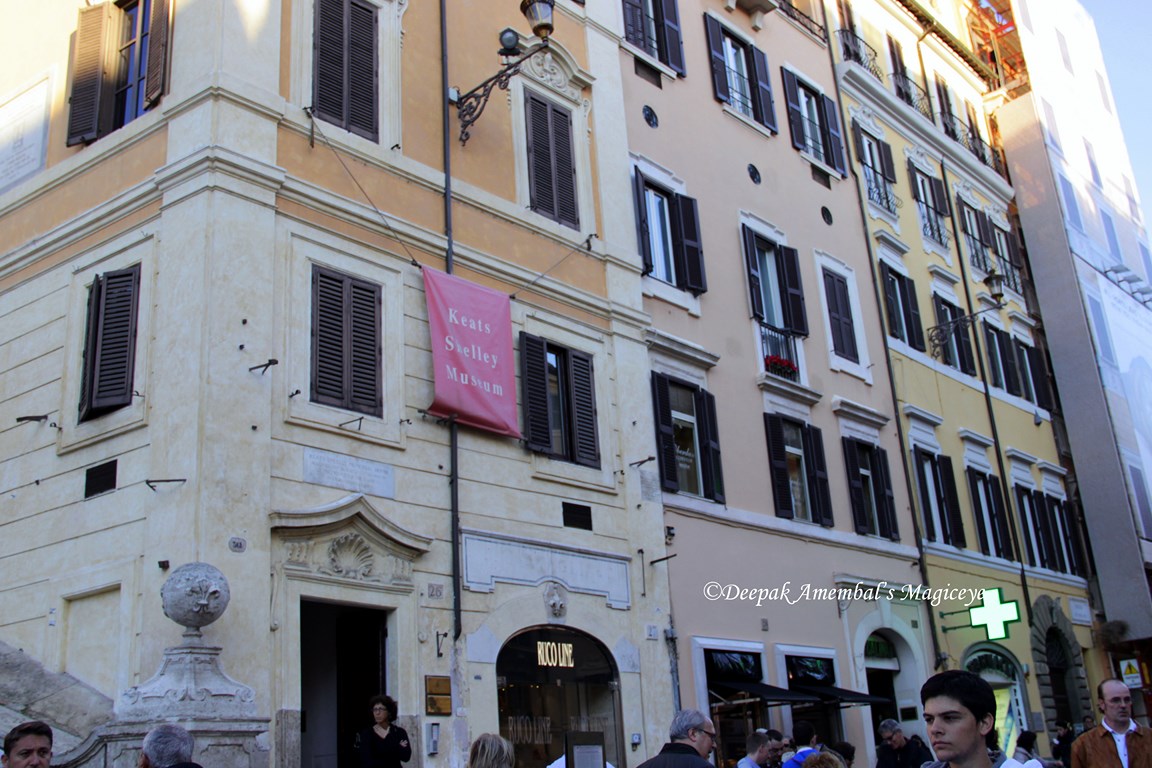
In the piazza there is the house where English poet John Keats lived and died in 1821; it is now a museum dedicated to his memory.


As we walk down a few steps we come across The Column of the Immaculate Conception, a nineteenth-century monument in central Rome, located in what is called Piazza Mignanelli. The column was dedicated on December 8, 1857. Atop the column is a bronze statue of the Virgin Mary, sculpted by Giuseppe Obici.


Further down the road we were shown the street where the local Romans did their classy shopping.


And then again another water fountain which was not only meant for humans but also animals!


We were taken aback when we were introduced to Galleria Alberto Sordi, a shopping arcade named after the actor Alberto Sordi. What a marvellous structure! It was built in 1914 on the site of Palazzo Piombino.


And on we marched to The Column of Marcus Aurelius, a Roman victory column in Piazza Colonna. It is a Doric column featuring a spiral relief: it was built in honour of Roman emperor Marcus Aurelius and modelled on Trajan's Column. The spiral picture relief tells the story of Marcus Aurelius’ Danubian or Marcomannic wars, waged by him from 166 to his death. The carvings are amazing!


Then it was The Palazzo Chigi that is the official residence of the Prime Minister of the Italian Republic.


The Temple of Hadrian is a temple to the deified Hadrian on the Campus Martius in Rome, Italy, built by his adoptive son and successor Antoninus Pius in 145 and now incorporated into a later building in the Piazza di Pietra (Piazza of Stone - derived from use of the temple's stones to build the piazza).


Now it was time for some excellent Italian coffee! It was aromatic and delicious. Now I know why Italians


love their coffee!


The Church of Saint Ignatius of Loyola at Campus is a Roman Catholic titular church dedicated to Ignatius of Loyola, the founder of the Jesuit order. This is absolutely amazing. This is a must see church.


The art inside is spellbinding!

The Pantheon was commissioned by Marcus Agrippa during the reign of Augustus as a temple to all the gods of ancient Rome, and rebuilt by the emperor Hadrian about 126 AD.


The building is circular with a portico of large granite Corinthian columns. A rectangular vestibule links the porch to the rotunda, which is under a coffered concrete dome, with a central opening to the sky. Almost two thousand years after it was built, the Pantheon's dome is still the world's largest unreinforced concrete dome. It is one of the best-preserved of all Roman buildings. It has been in continuous use throughout its history, and since the 7th century, the Pantheon has been used as a Roman Catholic Church dedicated to "St. Mary and the Martyrs" but informally known as "Santa Maria della Rotonda." The square in front of the Pantheon is called Piazza della Rotonda.


Our last stop was The Trevi Fountain. Standing 26.3 metres high and 49.15 metres wide, it is the largest Baroque fountain in the city and one of the most famous fountains in the world. It is believed that if one tosses a coin over ones shoulder in the fountain one’s wish will be realised or at least you will come back to visit Rome yet again!

Our Free walking tour of Rome operator was New Rome Do check them out if you visit Rome. We loved it!

Thursday, July 11, 2013

When in Rome...

Rome, one of the oldest cities in Europe and regarded as the birthplace of Western civilisation is an amazing city. It is the only city in the world that is the capital of two states, Italy and the Vatican! Since the 1st century AD, Rome has been considered the seat of the Papacy and in the 8th century it became the capital of the Papal States, which lasted until 1870. In 1871 Rome became the capital of the Kingdom of Italy, and in 1946 that of the Italian Republic.
  

When in Rome you must take a guided tour of the Coliseum to soak into the history behind that magnificent


 structure. Visit it at least twice. Once in daylight and once at night when it is beautifully lit up. It is listed as a


world heritage since 1980 by UNESCO.
It is the largest amphitheatre in the world and been in existence since 70-72AD. It was called Amphitheatrum Flavium as it was constructed by the Emperors of the Flavian dynasty. The name Coliseum is believed to have been derived from the colossal statue of Nero that was built just outside the amphitheatre. Now only the base of the statue exists.


Adjacent to the Coliseum is the Roman Forum. In Latin, Forum means plaza or square. This forum is


surrounded by the ruins of several important ancient government buildings and the ruins of the Roman kingdom's earliest shrines and temples.

In the next post we will take a walking tour of Rome.


Friday, March 29, 2013

Mount Vesuvius


We took a train to Erculaneum from Naples to visit the ticking time bomb - Mount Vesuvius. It was this volcano that erupted on 24 August in 79AD and destroyed Pompeii and Herculaneum killing around 16000 people. Its last eruption was in 1944 during World War II when it killed around 50 people and destroyed planes of the Allied forces in Italy.

Just outside the Erculaneum station we took a mini bus to Mount Vesuvius. The climb from where the bus dropped us was a steep 800m and took us half an hour.

Once on top we walked around the lip of the crater and saw smoke emanating from some parts of the volcano. It was a pretty scary sight. Experts warn that a future major eruption cannot be predicted but it would be devastating.


The view of the bay of Naples from the top is amazing. And they have thoughtfully placed benches up there so that the tourists can sit and relax and enjoy the views. I could not have 


asked for a better place to sit and sip on the rejuvenating Black Dog, a very fine Scotch. The feeling as the golden liquid flowed down my throat was amazing. An amazing scotch - the 


Black Dog at an amazing location. Could not spend much time there however as we had to get down to our bus to get back. Once back in the Hotel in Naples I continued my affair with Black Dog.

A new dimension to Living in Style!

Cheers!

Drink responsibly.


Thursday, March 28, 2013

Black Dog and Pizza

We took a train to Napoli or Naples from Rome. The journey was comfortable and took us just a couple of hours. Checked in to a hotel close to the Railway Terminus outside which there is the Bus terminus too. Plenty of pizza and coffee restaurants cheek by jowl with McDonalds lining the perimeter of the Terminus square.

Napoli is supposed to be the birth place of the Pizza and that obviously was our choice for dinner that night. Called for the Margherita. While on the walking tour of Rome the guide had


informed us that the Margherita pizza was tricoloured like the Italian flag Red (tomato sauce) White (mozzarella cheese) and Green (basil) and named after the Italian Queen Margherita.


To celebrate this wonderful creation we brought out the Black Dog eighteen year old that had a truly noble bouquet of luscious malty tones and rich velvety textures with a hint of oloroso sherry in the background. As we sipped it in between bites of the juicy delicious pizza we 


realized that the Black Dog was the perfect accompaniment with its round and mellow flavours with an impeccable balance of individual malt and grain whiskies and silky soft tones that dance on the tongue.

Perfect combination to Live in Style!

Cheers!

Drink responsibly.

Tuesday, March 26, 2013

Colosseum


Yesterday we visited the amazing Colosseum in Rome with an official guide who took us around and explained to us in great detail how the Colosseum got its name and also how it was used by Royalty. It was originally called the Amphitheatrum Flavium, as it was constructed by the emperors of the Flavian dynasty between 70-72AD. Nearby there was a colossal statue of Nero and people used to call the amphitheatre as the place near the Colossal statue which over the years came to be called the Colosseum.


The amphitheatre was used by the Emperors as a place for entertainment where various gladiators and animals fought each other. The Royalty and the VIPs had a special seating area from where they would watch the proceedings in the arena. There were separate seating areas for different classes of the people and it was free entry. Apparently all the fights did not end in the killing of gladiator and the Emperor would decide whether the loser would be killed or saved by signalling with a thumbs up for ‘Let him Live’.


Last night I dreamt I was seated in the Royalty Box of the Colosseum sharing my Black Dog with the 


Emperor. He was mighty impressed with the aroma and the taste of the 21 year old Black Dog. The aroma was a harmony of delight orchestrated by a multitude of seductive aromas of Soft peaches and ripe citrus fruits coupled with pear, marzipan and bergamot.


The taste was Bold and magnificent, perfectly suited for the action in the arena. The intense flavors of Seville oranges, ripe sweet mangoes and ginger spice rewarded the palate, and then whispers of bitter chocolate, liquorices and crushed almonds drift lovingly on.

And then the fight ended and the Emperor asked me to decide the fate of the loser. I gave a thumbs up sign as anyone who drinks Black Dog, the finest scotch ever, would!


Cheers!

Drink responsibly.


Grandmothers

Grandmothers are the pioneering influencers. I realised this after reading 'PapaMa's portrait' authored by my daughter Snehal A ...